Stripped Bare: How the Nikkei BP Teardown Exposed China’s EV Dominance
When Japanese specialist publisher Nikkei BP stripped down the BYD Seal alongside teardowns of the Atto 3, the project was far more than an engineering curiosity. Legacy carmakers across Europe and Japan—including Toyota, Honda, and Nissan—acquired the extensive technical dossiers to answer an urgent question:
How can Chinese manufacturers engineer high-spec electric vehicles at prices 25% to 35% lower than established European and Japanese brands?
Western observers have frequently attributed this pricing delta to state subsidies, currency manipulation, or cheap domestic labour. However, the physical evidence revealed by Nikkei BP points elsewhere. China’s commercial advantage is rooted in radical powertrain integration, structural packaging, and end-to-end supply chain ownership.
1. Key Engineering Discoveries from the BYD Seal Teardown
Nikkei BP’s physical deconstruction exposed three engineering practices that fundamentally differentiate BYD from legacy carmakers:
The '8-in-1' Integrated Electric Powertrain
Traditional EVs rely on discrete sub-assemblies connected across the chassis by metres of heavy, expensive copper cabling. These include:
Traction motor and reduction gearbox
Inverter and power distribution unit (PDU)
On-board charger (OBC) and DC-DC converter
Battery management system (BMS) and vehicle control unit (VCU)
BYD houses all eight components inside a single, tightly packaged casting. By sharing heat sinks, control circuit boards, and mounting points, BYD eliminates redundant aluminium enclosures, reduces wiring harness mass, and cuts line assembly steps substantially.
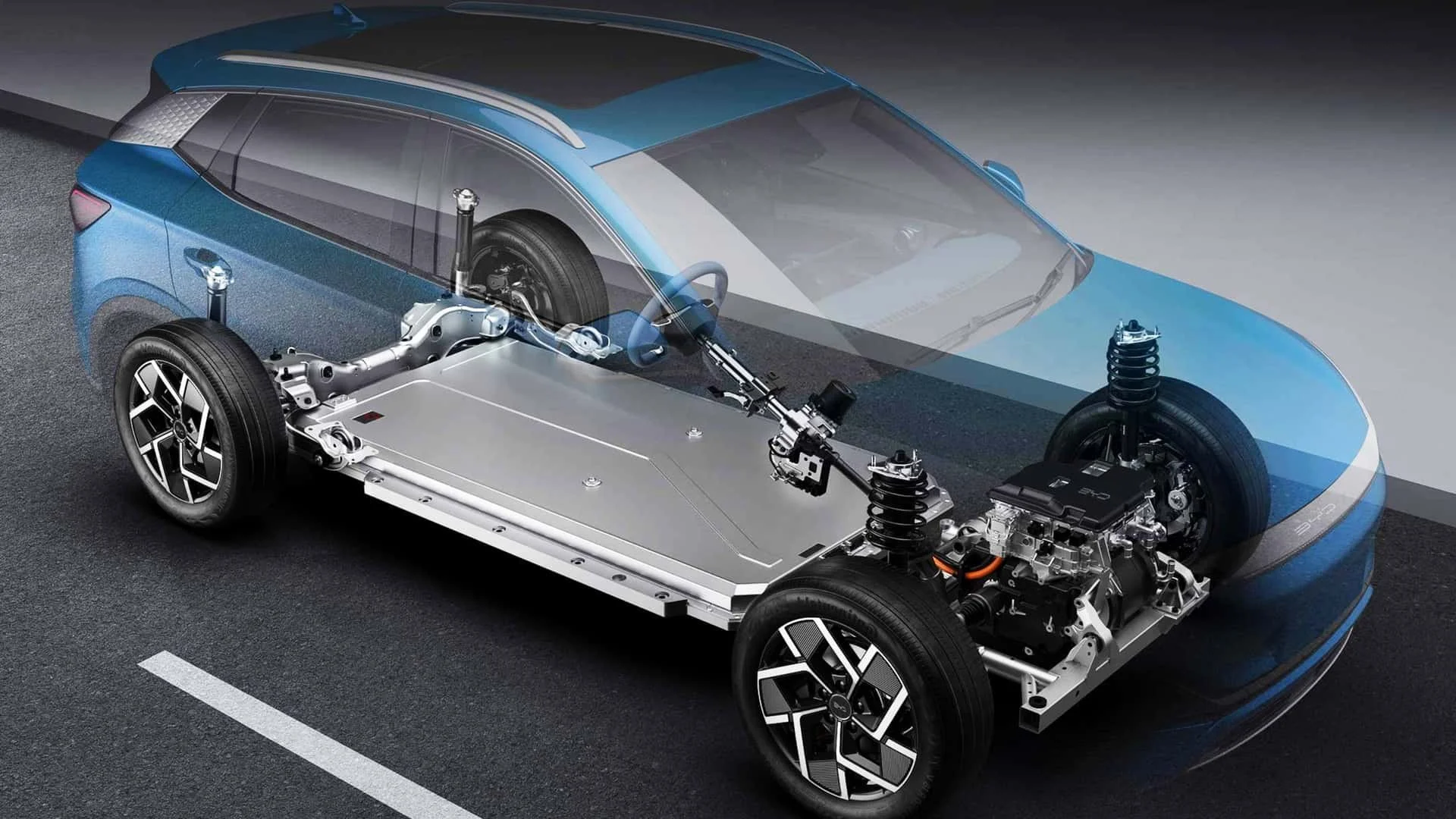
Cell-to-Body (CTB) Structural Packaging
Most legacy manufacturers follow a nested packaging workflow: individual battery cells are wired into modules, modules are secured inside a standalone battery pack, and the complete pack is bolted beneath the chassis.
BYD’s CTB technology discards this layered hierarchy:
Proprietary Blade Battery cells (Lithium Iron Phosphate / LFP) are bonded directly into the structural tub.
The battery's upper cover doubles as the vehicle's interior floor panel.
This sandwich design eliminates structural crossmembers, lowers kerb weight, increases torsional stiffness, and reduces raw material expenditure in the bill of materials (BOM).
Component Commonality Across Segments
Nikkei BP noted that BYD reuses electronic control boards, thermal management valves, and cabin sensors across completely disparate price points. Core silicon and actuators developed for the premium D-segment Seal are identical to units deployed in the mass-market Dolphin hatchback, generating massive volume economies of scale.
2. Why European and Japanese Manufacturers Face a Structural Cost Deficit
Independent teardown benchmarks by investment banks and engineering consultancies estimate that BYD builds EVs at roughly 15% lower cost than Tesla and 25% to 35% below European or Japanese legacy competitors.
Five structural characteristics explain this performance gap:
| Cost Driver | Legacy Automakers (Japan / Europe) | Chinese EV Manufacturers (e.g. BYD) |
|---|---|---|
| Supply Chain Model | Horizontal integration reliant on Tier-1 suppliers (Bosch, Denso, Valeo) | Near-total vertical integration; in-house semiconductors, dies, and motors |
| Battery Strategy | Heavy reliance on outsourced nickel-rich NMC cells | In-house LFP cell fabrication and upstream raw material processing |
| Development Cycle | Conservative 48- to 60-month platform cycles | Rapid 18- to 24-month consumer electronics iteration cycles |
| Component Sourcing | Multi-tiered markups across fragmented international borders | Hyper-dense regional manufacturing clusters within driving distance |
In-House Manufacturing vs. Multi-Tier Supplier Margins
Legacy OEMs act primarily as vehicle assemblers, sourcing subsystems from Tier-1 suppliers who bundle their own profit margins, overheads, and development costs into every component.
Conversely, BYD originated as a battery and electronics contract manufacturer. With the exception of windscreens, windows, and tyres, BYD fabricates nearly everything internally—including automotive semiconductors (BYD Semiconductor), microcontrollers, stamping dies, wiring looms, and seating frames. This eradicates supplier margins across the bill of materials.
Upstream Control of LFP Chemistry
Traction batteries represent roughly 30% to 40% of an electric car’s manufacturing cost. While European makers heavily adopted Nickel-Manganese-Cobalt (NMC) packs, Chinese firms concentrated on Lithium Iron Phosphate (LFP).
By removing volatile commodities like nickel and cobalt, cell-level chemistry costs fall by 20% to 30%. Because Chinese businesses dominate raw lithium refining and active material synthesis, they capture compounding savings throughout the manufacturing run.
Localised Industrial Clusters
In manufacturing centres across Shenzhen, Changzhou, and the Yangtze River Delta, the complete supply web—from permanent-magnet motor specialists to automated stamping suppliers—is co-located within easy freight distance. These geographic hubs compress lead times, reduce buffer inventory, and accelerate prototype testing.
Consumer-Electronics Development Cadence
Legacy vehicle programmes take four to five years to progress from initial clay modelling to showroom floors. Chinese brands treat vehicles as modular smart hardware, running parallel engineering sprints that yield new vehicle platforms in under 24 months. This rapid cycle lets them adopt falling semiconductor prices and improved cell densities years before legacy brands reach a scheduled mid-cycle refresh.
3. The Trade-Offs of Radical Integration
Nikkei BP's analysis confirmed that this integrated, low-cost engineering creates distinct real-world complications:
Collision Repairability Constraints: Because the battery doubles as the chassis floor, minor structural collisions that warp the bottom rail can render the vehicle uneconomical to repair, driving higher insurance write-off rates.
Escalating Insurance Premiums: In export territories like the UK and mainland Europe, insurers have flagged repair delays, scarce replacement components, and structural pack liabilities, resulting in elevated ownership costs for buyers.
Component Serviceability: Consolidating power electronics into an 8-in-1 assembly means an isolated fault in the on-board charger or DC-DC converter can require extracting and swapping the entire drivetrain unit rather than replacing an inexpensive individual part.
Summary
The Nikkei BP teardown shows that China's cost advantage is not a temporary anomaly sustained solely by export subsidies. It is the output of an integrated manufacturing model that treats the motor car as a piece of unified electronic hardware.
For European, British, and Japanese carmakers, matching these retail prices will take far more than incremental factory efficiency—it will require reshaping traditional supplier relationships, consolidating electronics architectures, and rethinking how electric cars are built from the ground up.