AI, ML & Deep Learning: What's Actually the Difference?
If you've ever nodded along in a conversation about artificial intelligence whilst having absolutely no idea what anyone was actually talking about, you're in very good company. These three terms — Artificial Intelligence, Machine Learning, and Deep Learning — get thrown around constantly, often interchangeably, as though they all mean the same thing. They don't. But here's the good news: once someone explains it properly, it all clicks rather nicely.
Let's fix that right now.
Think of It Like a Russian Nesting Doll
You know those Russian nesting dolls — Matryoshka dolls — where you open one and find a smaller one inside, and then another inside that? That's the perfect way to picture how these three concepts relate to one another.
The biggest, outermost doll is Artificial Intelligence
Nestled inside it is Machine Learning
And tucked inside that is Deep Learning
Every Deep Learning system is a Machine Learning system. Every Machine Learning system is a form of Artificial Intelligence. But not all AI is Machine Learning, and not all Machine Learning is Deep Learning. The three aren't rivals or alternatives — they're layers of the same idea, each one more specialised than the last.
Simple enough? Good. Now let's open each doll.

The Outer Doll: Artificial Intelligence
Artificial Intelligence is the broadest idea of the three. At its core, it simply means: a machine that can do something that would normally require human intelligence.
That's it. No smoke, no mirrors.
AI is the grand ambition — the overarching goal of making computers think, reason, learn, and make decisions in ways that feel, well, smart. This idea has been around since the 1950s, long before today's technology could support it properly.
Real-World Example
Think of the chess-playing computer that defeated world champion Garry Kasparov back in 1997 — Deep Blue. It wasn't learning or adapting; it was following an enormous set of rules and calculating millions of possible moves ahead. That's still AI. It was programmed intelligence — a machine doing something requiring human-level strategic thinking, even if it worked very differently from a human brain.
Other everyday examples of AI (in its broadest sense) include:
Sat-navs calculating the fastest route
Spam filters deciding which emails belong in your bin
Customer service chatbots answering your queries at 2am
“AI is any technique that allows machines to mimic human behaviour.”
The approach might vary wildly — rules, logic, statistics, or pattern recognition — but if a machine is doing something smart, it's AI.

The Middle Doll: Machine Learning
Now we open the outer doll and find Machine Learning inside.
Machine Learning is a specific approach to building AI. Rather than programming a computer with a rigid set of rules (like Deep Blue), you instead feed it data and let it figure out the rules for itself. The machine learns from experience, improving over time without being explicitly told what to do at every step.
Think of it this way: instead of writing out every rule for identifying a cat in a photo, you show the system thousands of cat photos and thousands of non-cat photos. Over time, it picks up patterns — pointy ears, whiskers, those judgmental eyes — and learns to recognise cats on its own.
Real-World Example
The best everyday example? Netflix recommendations.
Netflix doesn't have someone sitting in an office manually deciding what you should watch next. Instead, its Machine Learning system looks at your viewing history, what you've rated highly, what similar users enjoy, how long you watched before switching off, and dozens of other signals. From all of that data, it learns your taste and serves up suggestions that feel surprisingly personal.
The same principle applies to:
Spotify's Discover Weekly — learning your music taste to build a weekly playlist
Amazon's "Customers also bought..." — spotting purchasing patterns to suggest products
Your bank's fraud detection — learning what your normal spending looks like, then flagging anything unusual
“Machine Learning is what happens when you teach a computer to learn from data rather than programming it with every possible answer.”
The more data it sees, the better it gets. That's the real magic.
The Inner Doll: Deep Learning
Now we open the middle doll — and here, tucked right at the centre, is Deep Learning.
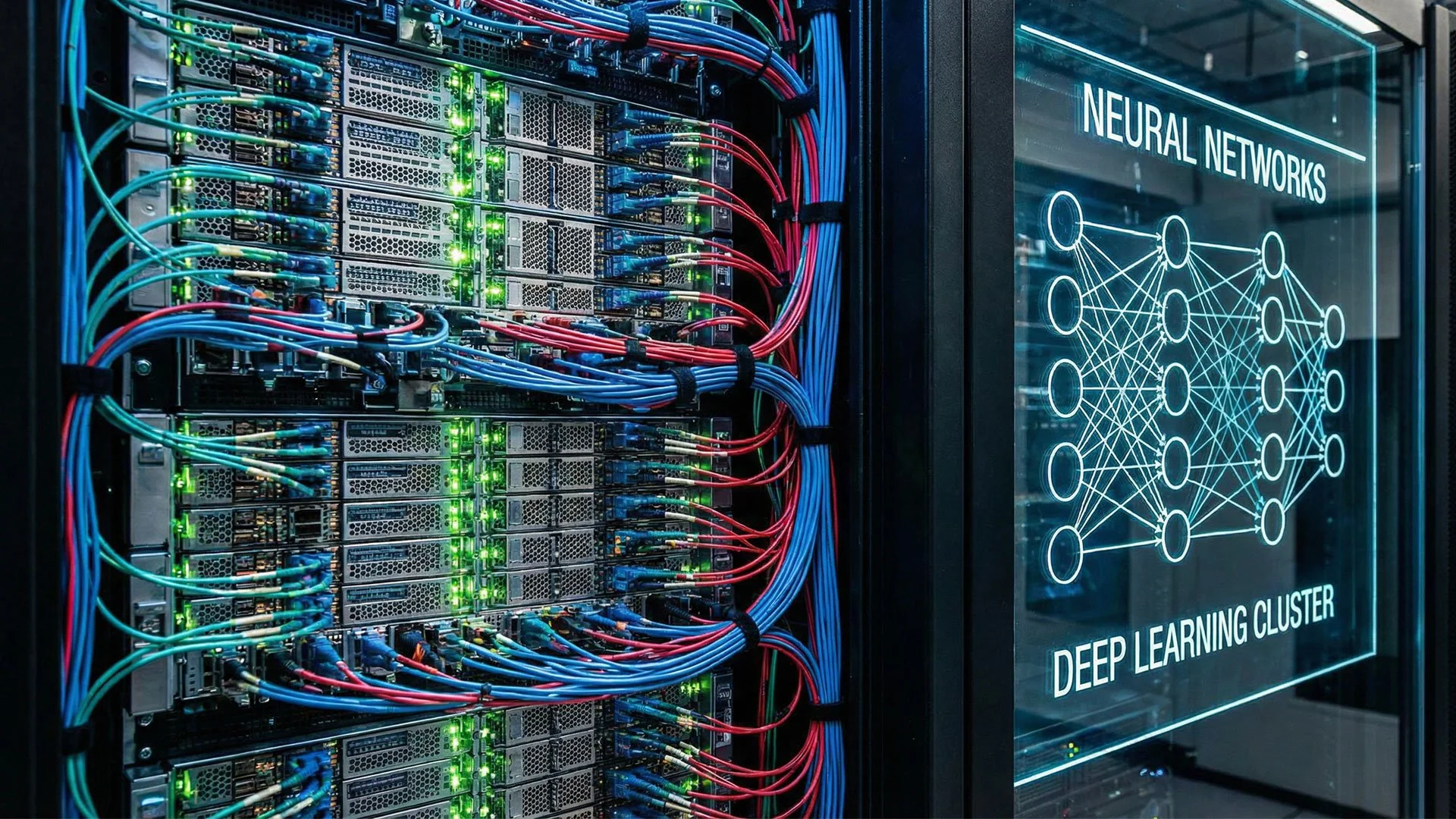
Deep Learning is a specific type of Machine Learning, inspired (loosely) by how the human brain works. It uses structures called neural networks — layers upon layers of mathematical functions that process information in increasingly complex ways, a bit like signals passing through neurons in your brain.
The "deep" in Deep Learning refers to the depth of these layers. You might have an input layer receiving raw data, several hidden layers finding patterns within patterns, and an output layer delivering a decision. The more layers, the "deeper" the network, and the more sophisticated the things it can learn.
The key difference from standard Machine Learning? You barely need to tell it what to look for. A traditional ML system might need a human to highlight relevant features in data — "look at the edges, look at the colour, look at the shape." A Deep Learning system works most of that out entirely on its own, given enough data and computing power.
Real-World Example
Voice assistants like Siri, Google Assistant, or Alexa rely heavily on Deep Learning. Understanding natural human speech is fiendishly difficult — we mumble, we use slang, we speak in different accents, we trail off mid-sentence. Deep Learning systems trained on vast amounts of spoken audio have become remarkably good at parsing all of that, in real time.
Other brilliant examples include:
Facial recognition on your phone unlocking with a glance
Self-driving car systems are interpreting what's happening around the vehicle
AI image generators like DALL·E or Midjourney are creating images from written descriptions
Medical imaging tools are detecting cancerous cells in scans with remarkable accuracy
“Deep Learning is the reason AI suddenly got dramatically better at seeing, hearing, and understanding the world around us — particularly from the 2010s onwards.”
It's hungry for data and computing power, which is why it only really took off once we had enough of both.
Putting the Dolls Back Together
Let's recap with a clean, side-by-side view:
| Artificial Intelligence | Machine Learning | Deep Learning | |
|---|---|---|---|
| What it is | Any machine doing something "smart" | AI that learns from data | ML using layered neural networks |
| How it works | Rules, logic, or learning | Finds patterns in data | Finds patterns within patterns, automatically |
| Needs lots of data? | Not necessarily | Yes | Absolutely — the more the better |
| Example | Chess computer, sat-nav | Netflix recommendations | Voice assistants, facial recognition |
| Age of idea | 1950s | 1980s–90s | Took off in the 2010s |
So, Why Does This Actually Matter?
These distinctions shape how technology is built, what it can do, and where its limits lie. A traditional AI system following rigid rules will always be limited by whoever wrote those rules. A Machine Learning system can surprise you — it might spot a pattern no human thought to look for. And a Deep Learning system can do things that frankly still feel a little magical, like generating a painting in the style of Monet from a sentence you typed.
Understanding the difference also helps you cut through the hype. When a company says their product is "powered by AI," you can now ask: what kind of AI, exactly? Is it a clever set of if/then rules? Is it learning from your data? Is it a deep neural network trained on billions of examples? Those are very different things, with very different implications — for capability, for privacy, and for trust.
The Bottom Line
Artificial Intelligence is the big picture — the dream of intelligent machines.
Machine Learning is one powerful way of achieving it — teaching machines through data.
Deep Learning is the most sophisticated flavour of ML — using layered networks to tackle the most complex tasks.
They're not competing ideas. They're nested ones. And now, the next time someone drops these terms into conversation, you won't just nod along — you'll actually know exactly which doll they're talking about.